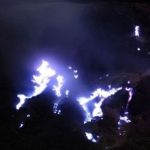
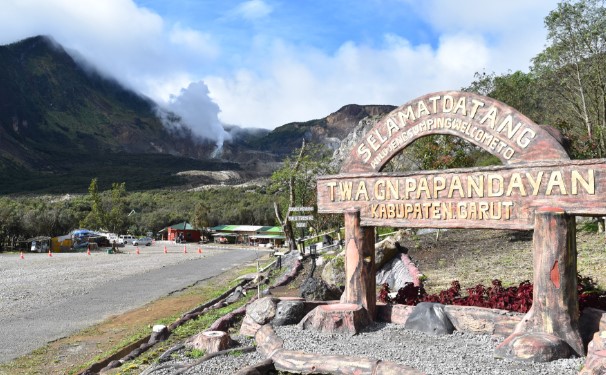
The rare blue flame phenomenon that recently appeared at Kawah Manuk, on Mount Papandayan, has become a new draw for hikers. But Indonesia’s Geological Agency, under the Ministry of Energy and Mineral Resources (ESDM), is warning that toxic volcanic gas emissions remain a genuine health risk for visitors.
Toxic Gas Still Being Released, Even After the Flames Faded
The Geological Agency says toxic gas is still being released in the Kawah Manuk area, even though the visible blue glow that appeared a few days earlier has since died down.
Geological Agency Head Lana Saria explained that the blue fire phenomenon, first observed in the early hours of September 24, 2026, emerged at a new heat manifestation point within Kawah Manuk, part of the Mount Papandayan complex in Garut Regency, West Java.
What Caused the Blue Glow
Based on monitoring by the emergency response team from the Center for Volcanology and Geological Disaster Mitigation (PVMBG), the blue light was triggered by a significant release of thermal energy. That heat burned surface material within the crater, leaving behind ash residue as a byproduct of the combustion process.
“Although thermal activity has decreased, gas conditions around the location still show significant volcanic gas release. A strong sulfur smell can still be detected downwind from the manifestation site, meaning the gas in the surrounding area still carries potential health risks for anyone directly exposed,” Lana said in the Geological Agency’s evaluation report, as quoted by Antara on Monday, September 28, 2026.
An Extremely Rare Phenomenon
Blue fire at Mount Papandayan is considered an extremely rare natural phenomenon. It has only been recorded twice before, on February 22, 2023, and July 12, 2025, both occurring on the walls of the same new crater. A similar, well-known version of this phenomenon also occurs at Mount Ijen in East Java.
What makes this latest occurrence particularly concerning is its location. The blue fire at Kawah Manuk sits very close to the mountain’s main hiking trail and a popular tourist camping ground, demanding heightened caution from all parties involved, including park management, hikers, and local authorities.
Alert Level Remains Normal, But Safety Guidelines Issued
The Geological Agency has confirmed that Mount Papandayan’s current activity level remains classified as Level I (Normal). However, the agency has issued four key safety recommendations for visitors and managers of the Mount Papandayan Nature Tourism Park:
- No activity or overnight stays within 500 meters of active crater openings (New Crater, Gold Crater, Nangklak Crater, and Manuk/Balagadama Crater), particularly during cloudy or rainy weather.
- Watch for sudden increases in toxic gas concentration, which can shift unpredictably depending on wind direction.
- Be alert to the potential for phreatic eruptions, which can occur suddenly without clear preceding volcanic warning signs.
- Watch for landslide risks on crater walls surrounding the active crater complex.
- A Call for Strict Safety Enforcement
The Geological Agency is urging managers of the Mount Papandayan Nature Tourism Park to strictly enforce the recommended safe distances, in order to protect hiker safety and prevent activity in areas prone to toxic gas exposure.
Why the Phreatic Eruption Warning Matters
The warning about phreatic eruptions deserves particular attention. Unlike typical volcanic eruptions that are often preceded by detectable warning signs, phreatic eruptions occur when heated groundwater or trapped steam suddenly flashes into pressurized vapor, triggering an abrupt explosion with little to no prior indication.
This unpredictability is precisely why authorities are emphasizing distance restrictions rather than relying solely on real-time monitoring to protect visitors.
How to Stay Informed
The public and travelers interested in visiting Mount Papandayan can monitor the latest volcanic activity updates through official PVMBG channels and the magma.esdm.go.id portal, both of which provide ongoing assessments as the situation at Kawah Manuk continues to be evaluated.
What This Means for Travelers
For hikers drawn to Mount Papandayan specifically to witness or photograph the blue fire phenomenon, this warning serves as an important reminder that natural beauty and genuine danger can coexist in volcanic environments. Even though the alert level remains at Normal and the visible flame has faded, the underlying toxic gas emissions mean the area still requires serious caution.
Anyone planning a visit should strictly follow the posted safe distance guidelines, avoid camping or lingering near active crater zones, and stay updated through official channels before and during their trip, rather than relying on outdated information or secondhand accounts of the area’s current conditions.