Fiji, the island nation tucked in the southern Pacific Ocean, recently found itself in the spotlight for an unexpected reason: its president wore a skirt to the World Water Forum in Bali.
The Fijian president drew widespread attention for his distinctive attire at the event, wearing what’s known as a “sulu”, Fiji’s national dress for men.
Fiji has long been known for its stunning natural scenery, white sand beaches, and rich culture. Most of Fiji’s islands were formed through volcanic activity, sediment deposits, and coral formations.
The name “Fiji” comes from an old Tongan word for the islands, which itself was derived from the Fijian name “Viti.”
Despite its reputation as a tropical paradise, plenty of travelers still don’t know much about this hidden gem in the Pacific. Here’s a rundown of some genuinely interesting facts about Fiji.
1. A History Shaped by Colonization and Coups
Fiji’s first inhabitants arrived from Southeast Asia long before any contact with European explorers in the 17th century. Records show Fiji was first encountered by Dutch explorer Abel Tasman while searching for the Great Southern Continent in 1643.
However, it wasn’t until the 19th century that Europeans began settling the islands permanently. Fiji became a British colony in 1874 and gained independence in 1970.
Fiji’s democratic governance was disrupted by two military coups in 1987, triggered by concerns that the government at the time would become dominated by the Indo-Fijian community.
The second 1987 coup led to the abolition of the British monarchy’s role, replacing the Governor-General with a non-executive Fijian President, and changing the country’s name from the Dominion of Fiji to the Republic of Fiji (later renamed the Republic of the Fiji Islands in 1997).
2. Home to Hundreds of Uninhabited Islands
Fiji consists of 322 islands, with 106 of them uninhabited, plus another 522 smaller islets. The two most significant islands are Viti Levu and Vanua Levu.
The country’s capital, Suva, is located on Viti Levu, home to 75% of Fiji’s population. The island features extensive mountainous terrain, with its highest point reaching 1,200 meters above sea level, surrounded by tropical rainforest.
3. A Population With Deep Indian Heritage
While Fiji’s indigenous population is generally classified as Melanesian, their social and political structures actually resemble Polynesian traditions more closely. Indigenous Fijians make up more than half the population, while roughly two-fifths are of Indian descent.
4. Three Official Languages
Fiji has three official languages enshrined in its constitution: English, introduced by British colonizers; Bauan Fijian, used by ethnic Fijians; and Fiji Hindi, used by the Indo-Fijian community.
Fijian citizens have the right to use any of these three languages when communicating with the government. That said, English remains the most commonly used language, a legacy of more than a century under British colonial rule.
Fijian belongs to the Austronesian language family and is closely related to Polynesian languages. Many Fijian dialects exist, but the standard dialect is Bauan.
5. Fiji’s Top Tourist Destinations
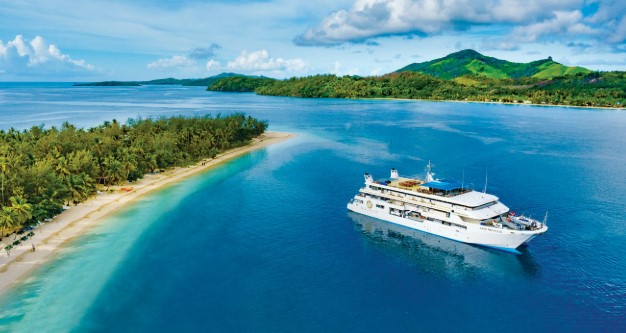
As an island nation, Fiji offers a range of stunning destinations that draw travelers from around the world. The Mamanuca Islands, for instance, are known for beautiful beaches, crystal-clear waters, and striking coral reefs, making them a popular spot for snorkeling, diving, and other water sports.
Taveuni Island, known as the “Garden Island,” is a paradise for nature lovers, home to Bouma National Park and renowned dive sites like Rainbow Reef.
The Coral Coast, located along Viti Levu’s southern shoreline, is another popular destination for families and couples, offering a range of resorts, beautiful beaches, and activities including snorkeling, diving, and boat tours.
6. Why the British Union Jack Still Appears on Fiji’s Flag
Fiji’s flag, featuring a light blue background symbolizing the Pacific Ocean, carries a notable element: the British Union Jack in the upper left corner. Its presence is a reminder of Fiji’s history as a British colony from 1874 until achieving independence on October 10, 1970.
At the center of the flag sits Fiji’s coat of arms, depicting the country’s natural life and resources, including sugarcane, coconuts, a dove of peace, and bananas.
Together, these elements reflect a unique blend of colonial history and national identity, capturing Fiji’s journey from colony to an independent, sovereign nation.
Beyond its postcard-perfect beaches, Fiji carries a genuinely layered history and cultural identity shaped by Melanesian roots, Indian heritage, and British colonial influence, a combination that makes it far more interesting than just another Pacific island getaway. For travelers planning a trip, understanding this backstory adds real depth to a visit, whether you’re diving Rainbow Reef in Taveuni or relaxing along the Coral Coast.