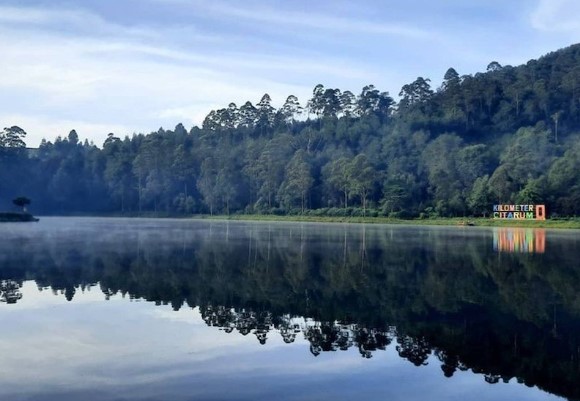
Deep within the lush forests of Kertasari District, Bandung Regency, lies a crystal-clear lake at the foot of Mount Wayang. Its name is Situ Cisanti.
This five-hectare expanse of water in Tarumajaya Village is more than just a scenic spot. For the people of West Java, Situ Cisanti represents nothing less than the breath of life itself.
Where the Citarum River Begins
This is the exact starting point of the Citarum River, which flows nearly 300 kilometers across multiple cities before emptying into Muara Gembong, Bekasi, and finally reaching the Java Sea.
While the Citarum River is often associated with pollution downstream, its headwaters tell a completely different story. The water here remains remarkably clear, reflecting the tranquility of a forest that’s stayed largely untouched.
From Natural Swamp to Man-Made Lake
Atep Permana, 54, the site’s traditional caretaker (juru kunci), explained that this area was originally a natural swamp at the foot of Mount Wayang. Its transformation into a man-made lake only happened when the government developed the site in the early 2000s.
“So this used to be a natural swamp. Then, starting from 2001 to 2002, it was developed and named Situ Cisanti, which it’s still called today,” Atep said.
Even though the reservoir itself is relatively new, the water sources here have been part of local legend since the time of earlier generations. Long before the name “Situ Cisanti” existed, these springs had already been protected across generations by Atep’s own family.
“So this area used to be looked after by my parents. When the development happened, government officials consulted with my parents about what to name the site,” he said.
Seven Sacred Springs Feeding the Citarum
Within this area lie seven main water springs that local communities have long depended on: Citarum, Cikahuripan, Cikoleberes, Cihaniwung, Cisadane, Cikawudukan, and Cisanti.
“These seven springs all collect into Situ Cisanti. In the past, the water flowed directly from the foot of Mount Wayang. Now, it flows from Mount Wayang, collects at Situ Cisanti through these seven springs, and then continues into the Citarum River,” Atep explained.
He emphasized that this exact spot marks the true beginning of the Citarum River’s long journey. “This is the zero point of the Citarum River. So the Citarum’s entire journey, all the way to Bekasi, starts right here,” he said.
What Visitors Come to See
For visitors, the Citarum and Cikahuripan springs are the main draw. Both are located side by side in the deepest part of Situ Cisanti, tucked behind dense tree cover.
“So once you enter, the spring on the right is Citarum, and the one on the left is Cikahuripan. These two springs are separated by trees as you walk in from the entrance,” Atep described.
The other springs are scattered around the lake’s edges. The Cisanti spring itself sits about two kilometers outside the main gate, though its flow still ultimately reaches the lake.
The Deep Philosophy Behind Each Spring’s Name
For local communities, these seven springs aren’t merely water sources, they carry deep philosophical meaning tied to how one should live. The Citarum spring, for instance, is understood as a reminder that people should pray for one another if they wish their lives to be “harum” (fragrant, meaning good and honorable). Cikahuripan symbolizes water that sustains life itself.
“Cikahuripan represents life, ‘hirup’ and ‘hurip’ both relate to living. Then there’s Cikoleberes, meaning we must set things right, whether it’s matters of the heart, daily affairs, or our conduct, everything needs to be resolved properly,” Atep explained.
Deeper meaning is also woven into Cihaniwung and Cisadane, which carry the message that people shouldn’t chase worldly matters endlessly while forgetting to prepare for the afterlife. Cikawudukan, the sixth spring, serves as a reminder to avoid a hardened heart.
“Then there’s Cikawudukan, the sixth spring. This one teaches us not to hold onto a hardened heart, no grudges, no envy, no malice allowed. That’s why men are called to be righteous (saleh) and women to be righteous (salehah), meaning, don’t carry a hardened heart within you,” he said.
Finding “Cisanti” Within Yourself
Atep explained that understanding and living out the meaning behind these six springs ultimately leads a person to true “Cisanti”, an inner tranquility held within the heart.
“So once the meanings of springs one through six are understood, interpreted, and practiced, you arrive at Cisanti itself, stored within the heart. Once we understand what’s been explained, it needs to be read, practiced, and then it settles within us,” he continued.
Water Pure Enough to Drink
As the keeper of this tradition, Atep holds firmly to his family’s responsibility to continue caring for this area. Thanks to strict adherence to local wisdom in protecting the site, the water at Situ Cisanti remains pure and safe for consumption.
“Alhamdulillah, to this day, this spring water can still be drunk directly. We’re grateful we can still enjoy it and drink it straight from the source, it’s completely safe,” Atep said.
A Site Steeped in History and Legend
Beyond its ecological and philosophical significance, Situ Cisanti also carries historical weight as a site believed to be linked to King Siliwangi and Dipatiukur. At the bottom of one of the springs lies a stone that local communities believe bears the left footprint of the Pajajaran king.
“That really comes down to each person’s own beliefs. What matters to us is preserving local wisdom and the customs here, carrying forward this responsibility exactly as it was passed down, without adding to it or taking away from it,” Atep said.
A Place for Gratitude and Reflection
To this day, Situ Cisanti remains a destination for those seeking peace or simply wishing to express gratitude. The site becomes especially busy during the month of Maulud, when visitors arrive with genuine intentions to honor and appreciate nature.
“We’re grateful to the Almighty, and we also need to play our part in truly protecting this natural gift given by Allah Subhanahu wa Ta’ala. This is the teaching passed down from our parents and ancestors,” he concluded.
Why This Matters for Travelers
For travelers interested in destinations that combine natural beauty with genuine cultural depth, Situ Cisanti offers something increasingly rare: a site where ecological significance, local philosophy, and living tradition remain fully intact and actively practiced by its caretakers, rather than packaged purely for tourism.