
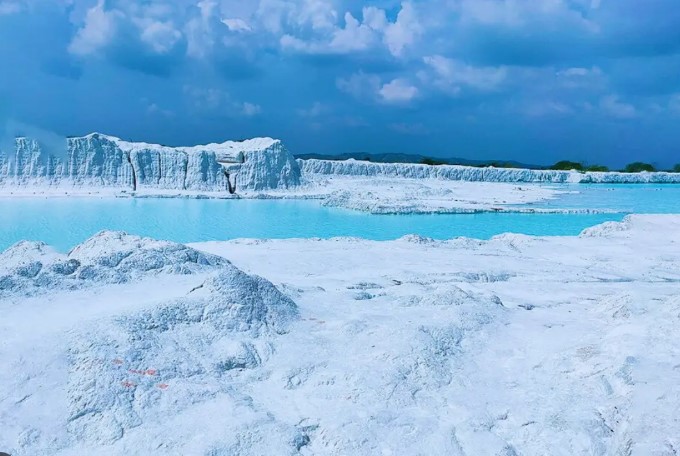
The Kishangarh region in Rajasthan, India, has an unusual landscape that’s been drawing tourists for all the wrong, or maybe right, reasons. Sprawling white mounds that look strikingly like snow are, in reality, industrial waste from the region’s marble and granite processing industry.
From Industrial Waste Site to Accidental Tourist Attraction
Kishangarh is one of India’s major marble processing hubs. White sludge and stone fragments left over from cutting and polishing marble are dumped in the area, and according to France24, reported Friday, August 21, 2026, the dumping site spans roughly 33 hectares. More than 5,500 tons of waste are delivered there daily from over 1,200 marble processing units.
That volume makes it one of the largest marble waste dumping sites in Asia. But rather than deterring visitors, the site’s strange, snow-like appearance has turned it into an unlikely tourist draw.
Prewedding Photoshoots and Horseback Rides Through “Snow”
Engaged couples now travel to Kishangarh specifically for prewedding photoshoots against the white backdrop. Film crews and music video productions have also used the mounds as a filming location.
Visitors can even ride horses across the waste-covered terrain. The sweeping white landscape has grown increasingly popular after photos of the site went viral on social media, with many visitors comparing Kishangarh’s scenery to the snow-capped Alps.
After rainfall, pooled water settling between the waste mounds forms bright blue ponds, adding an even more surreal, otherworldly quality to the landscape.
The Environmental Reality Behind the Photos
Behind its photogenic appeal, though, the area carries serious environmental concerns. Local authorities have repeatedly warned about the impact of marble waste disposal, ranging from airborne dust to potential groundwater contamination.
Several studies have found elevated salinity and mineral levels, along with traces of heavy metals, in water sources around the area.
In January, India’s highest environmental court ordered a series of corrective measures, including promoting the reuse of marble sludge and halting uncontrolled waste dumping practices.
“There is no engineered protective lining system, no decantation wells, no dust control mechanism, no air or groundwater monitoring, and no protective green belt,” the court stated in its ruling.
Tourists Keep Coming Anyway
Despite the ongoing environmental concerns, none of it has stopped tourists from visiting. Visitors remain drawn to seeing the white, snow-like landscape in person, even knowing what it actually is.
What This Means for Travelers Considering a Visit
If you’re considering a visit to Kishangarh for its unusual scenery, it’s worth keeping the environmental context in mind, this is an active industrial waste site with documented air quality and groundwater contamination concerns, not a natural attraction.
Anyone planning to visit should take basic precautions, such as avoiding prolonged exposure to airborne dust and being mindful of local advisories, rather than treating it purely as a scenic backdrop for photos.