
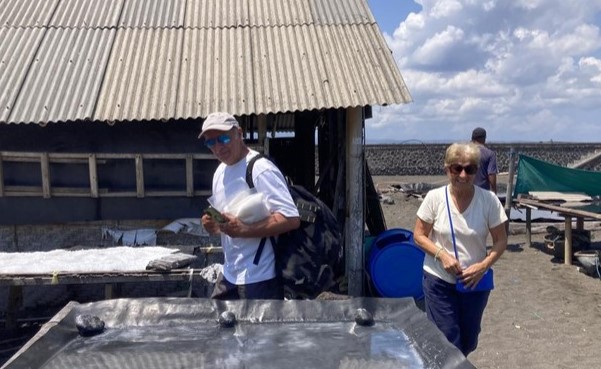
French tourists Jean Luc and his partner Maria became captivated by the unique traditional salt from Kusamba Village and the age-old process behind making it, captivated enough to buy a batch to bring home to France.
Jean and Maria arrived at the Kusamba salt farmers’ area around 11:00 AM local time. They approached local salt farmer Nengah Kerta, 63, to learn about the history and process behind making salt using troughs carved from coconut palm trunks.
Speaking to detikBali, Jean said he discovered Kusamba salt through an internet search. He and his partner had deliberately been seeking out traditional salt-making sites ever since their trip to Flores, East Nusa Tenggara (NTT).
“We were really drawn to the distinctive production process using coconut palm trunks. Especially since it’s been made this way since the kingdom era. So we wanted to see the process firsthand and try it for ourselves,” Jean explained.
Despite his fascination, Jean mentioned one small complaint: a lack of proper signage directing visitors to the salt farm’s location. Even so, he said he was actually grateful the site hadn’t been heavily commercialized as a mainstream tourist attraction. “Because it would get crowded, and it wouldn’t feel as special once it becomes a mainstream tourist destination,” he added.
After watching the production process up close and sampling the salt himself, the French traveler ended up purchasing 2 kilograms of Kusamba salt directly from Nengah Kerta, priced at Rp 50,000 per kilogram.
A Familiar Sight for Local Farmers, With a Language Barrier
Nengah Kerta shared that visits from foreign tourists to his salt farm aren’t unusual. Visitors are often curious about the price and the traditional production method. That said, he frequently runs into a language barrier when tourists arrive without a tour guide.
“Like these French tourists, they came just the two of them. Usually, if there’s a guide with them, they ask a lot of questions and I explain everything. Some visitors just look around, while others go ahead and taste the salt too,” Kerta explained.
A Salt With Official Recognition, and Real Health Benefits
For context, traditional Kusamba salt, shaped using coconut trunk troughs, has held a Geographical Indication (GI) Intellectual Property Rights certificate from Indonesia’s Ministry of Law and Human Rights since January 16, 2022.
What sets Kusamba salt apart is its distinctive, clean salty flavor without bitterness, naturally enhancing the taste of dishes it’s used in.
Beyond flavor, this salt is also said to be rich in calcium, magnesium, and potassium, offering health benefits compared to standard industrial salt. It’s produced entirely through solar power and traditional methods passed down from earlier generations, without any added bleaching agents or preservatives.
A Legacy Craft Facing a Market Slowdown
Despite this official recognition, salt farmers are currently facing a genuine market challenge. I Nengah Diana, 51, Head of the Sarini Segara Kusamba Salt Farmers Group, acknowledged this difficulty directly.
Diana revealed that most farmers have been forced to temporarily halt production of trough-method salt. “Demand for the trough-method salt has almost completely dried up. It’s probably because of the higher price,” Diana explained.
During harvest season, trough-processed salt can sell for Rp 30,000 to Rp 40,000 per kilogram, more than double the price of membrane-processed salt, which typically ranges between Rp 15,000 and Rp 25,000 per kilogram.
Beyond price, production volume for trough-method salt is also considerably lower. While the membrane method can yield around 2 kilograms per batch, the trough method produces only half a kilogram to one kilogram at a time.
Even with trough-method production currently stalled, Diana noted that overall harvest results this dry season have been quite strong. Farmers are still producing 35 to 40 kilograms of salt per day, sold at a standard price of Rp 15,000 per kilogram.
Why This Matters for Travelers Interested in Culinary Heritage
For travelers drawn to authentic, small-scale culinary craftsmanship, Kusamba’s traditional salt farms offer a genuine, uncommercialized glimpse into a centuries-old Balinese tradition, the kind of experience that risks disappearing if demand for the labor-intensive trough method continues declining. Visiting directly, buying from farmers like Nengah Kerta, and asking questions about the process isn’t just a memorable travel experience; it’s also a small but meaningful way to support the survival of this heritage craft.