
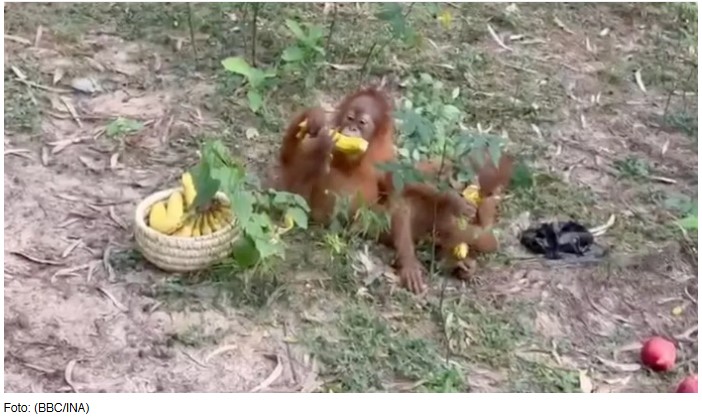
India’s Odisha state was left stunned after five baby orangutans were discovered deep in a forest, thousands of kilometers from their natural habitat. Authorities now suspect the animals were smuggled in from Southeast Asia.
Photos and videos showing the five orangutans sitting in the forest eating bananas quickly spread across India. Odisha’s Forest Minister confirmed that investigators are examining whether the animals were trafficked into the country by an international smuggling network and later abandoned near a highway, according to the BBC, reported Friday, September 11, 2026.
Officials emphasized that orangutans are not native to India at all. This endangered primate species is found only in Indonesia and Malaysia.
How the Orangutans Were Found
The baby orangutans were rescued on the morning of Tuesday, September 8, 2026, in Balasore district. Local residents first spotted the young animals near a residential area and reported the sighting to forest officials.
Officers administered first aid before transferring the animals to Nandankanan Zoological Park in Bhubaneswar, the state capital. During the ongoing investigation, all five will undergo a period of quarantine and monitoring.
Balasore District Forest Officer Pratik Prakash Indalkar told the BBC that these animals couldn’t possibly have reached Odisha naturally, and were most likely transported overland.
“All five animals were found in Ranakata, an area proposed as a protected forest in the Bhogarai block, near the West Bengal border,” he said.
A Journey of Roughly 3,600 Kilometers
Three orangutan species are currently protected under the International Union for Conservation of Nature (IUCN): the Bornean, Sumatran, and Tapanuli orangutans. If these baby orangutans originated from Kalimantan (Borneo), Indonesia, they would have traveled roughly 3,600 kilometers to reach where they were found.
Forest officials believe the orangutans had only been in the area for two to three days.
“The area is mostly covered with casuarina trees and isn’t dense forest. It’s also located close to a state highway,” Indalkar explained.
A search of the surrounding forest turned up no other orangutans, nor any clues about how the animals ended up there. The young orangutans are estimated to be between one and two years old.
Why This Discovery Is So Alarming
Young orangutans typically stay with their mothers for several years, learning the skills needed to survive independently. Female orangutans also have an unusually slow reproductive rate, typically giving birth only once every eight years.
The discovery of five young orangutans together, thousands of kilometers from their natural habitat, with no adult orangutans anywhere nearby, has raised serious concerns among officials about exactly how they ended up in Odisha in the first place.
A Species Already Under Threat
Orangutan populations have declined dramatically over the years due to deforestation, habitat loss, and hunting.
International commercial trade of orangutans is banned under CITES, the global treaty regulating trade in endangered species. They are also protected under India’s own wildlife protection laws.
Despite these protections, orangutans continue to be illegally trafficked, often destined to become exotic pets or additions to private collectors.
Not the First Case in India
This isn’t the first time young orangutans have turned up in India. In 2022, two baby orangutans were found abandoned at a checkpoint near the border between Assam and Mizoram states in India. Authorities at the time suspected the animals had been smuggled into India through neighboring Myanmar.
Why This Matters Beyond India’s Borders
This case is a stark reminder of how far-reaching illegal wildlife trafficking networks have become, and how species native to Indonesia and Malaysia can end up thousands of kilometers away in the hands of smugglers. For travelers who care about wildlife conservation, cases like this underscore the importance of supporting only legitimate, accredited wildlife sanctuaries and conservation programs, and reporting any suspicious wildlife trade encountered while traveling.