
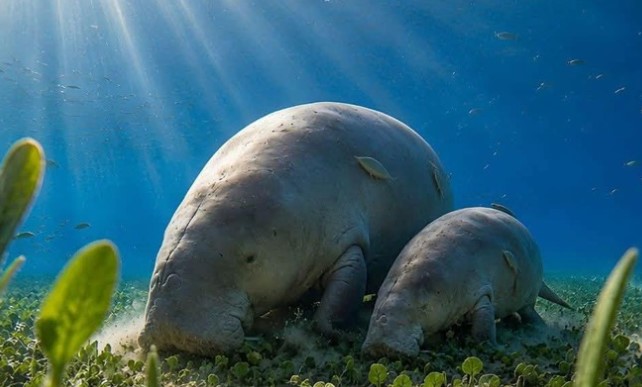
An AI art competition held in Thailand to raise awareness about dugong conservation has unexpectedly sparked controversy after the winning artwork showed the marine mammal with features that do not exist in real life.
The competition was organized by Thailand’s Department of Marine and Coastal Resources as part of the country’s National Dugong Conservation Day celebrations. Participants were asked to create artwork featuring dugongs, with a particular focus on protecting their natural habitat.
The winning entry, titled “Under the Azure Light,” quickly attracted attention online. However, instead of being praised for its creativity, the artwork became the subject of criticism because of its unrealistic depiction of both the dugong and its underwater environment.
According to The Thaiger, the competition offered a top prize of 3,000 baht, or roughly Rp 1.6 million. The identity of the winning artist has not been publicly revealed.
Winning AI Artwork Shows Dugong With Legs
One of the biggest problems noticed by online users was the appearance of hind legs on the dugongs shown in the artwork. In reality, dugongs are marine mammals with flipper-like front limbs and a distinctive forked tail. They do not have hind legs like land animals.
The seagrass shown in the image also drew criticism. Instead of resembling the narrow underwater plants found in Thai waters, the artwork depicted plants with unusually broad and rounded leaves growing from upright stems.
For some observers, the problem went beyond artistic interpretation.
Jessada Denduangboripant, a biology lecturer at Chulalongkorn University’s Faculty of Science, reportedly joined the discussion by sharing photographs of real seagrass found in Thailand in the comments section of the competition announcement.
His argument was straightforward: even when AI is used to create an artwork, an image produced for a conservation campaign should still reflect basic biological reality.
Conservation Message Becomes Part of the Debate
The controversy is particularly interesting because the competition was designed to promote conservation awareness in the first place.
The Department of Marine and Coastal Resources launched the contest to encourage the public to learn more about dugongs, their habitats and the importance of protecting areas where these animals live and feed.
Critics therefore questioned whether an inaccurate AI-generated image could undermine the very message the campaign was intended to deliver.
Some social media users also expressed concern that unrealistic images could create confusion, particularly among children who may not yet know what a real dugong looks like.
For them, the issue is not about whether AI art should be allowed in conservation campaigns. Rather, the concern is whether AI-generated content should be checked for factual accuracy before being selected as an official winning entry.
As of Tuesday, August 18, the department had not publicly responded to the criticism surrounding the artwork.
Thailand’s Dugong Population Faces Real Threats
Behind the online debate lies a much more serious conservation problem. Thailand is estimated to have around 250 dugongs, with a large portion of the remaining population found in Trang Province in southern Thailand.
The species has experienced a significant population decline over the years. Data from 2024 reportedly showed that starvation was the leading cause of dugong deaths in Thailand. The problem is closely connected to the loss of seagrass meadows, which are the primary food source for dugongs.
As their feeding grounds disappear, hungry dugongs are forced to travel farther in search of food. This can push them into areas with heavier boat traffic, increasing the risk of collisions with vessels. They can also become trapped in fishing gear, creating another major threat to the already vulnerable population.
Communities Join Efforts to Restore Seagrass
There is, however, some encouraging news.
Communities in Trang and Krabi have begun working with researchers to restore seagrass habitats. Local residents and scientists have been involved in replanting efforts aimed at rebuilding the underwater ecosystems that dugongs depend on.
Recent observations suggest that the dugong population has shown a small increase, offering a glimmer of hope for conservation efforts. The controversy surrounding the AI art competition may ultimately highlight an important lesson: technology can be a powerful tool for raising environmental awareness, but creativity should not come at the expense of accuracy.
For a conservation campaign, the image matters because the message matters. And when the subject is an endangered animal, showing people what that animal actually looks like,and what its real habitat needs,can be just as important as creating an eye-catching picture.