
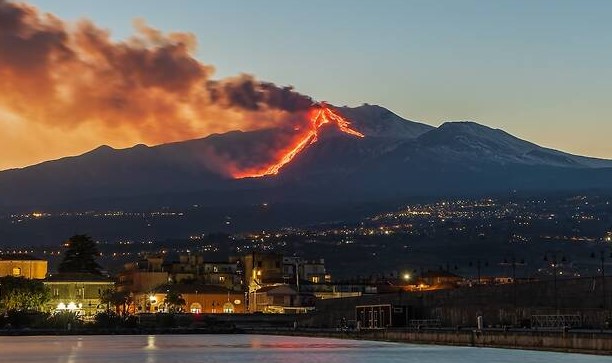
As Europe’s tallest active volcano, Mount Etna remains a major draw for tourists from around the world. Even amid ongoing eruption activity, some visitors still take the risk of hiking up its slopes. An American tourist died on Mount Etna on Sunday, August 16, 2026. The 29-year-old hiker was killed by a lightning strike at night in an exposed, barren area of the mountain.
An Extreme Storm With No Shelter in Sight
A sudden, extreme thunderstorm hit the volcano’s summit area, where hikers have no tree cover or shelter available above the tree line. An evacuation team arrived by helicopter at 8:00 PM local time. The hiker was rushed to Cannizzaro Hospital in Catania but was pronounced dead shortly after arrival.
The tourist, from Kansas, United States, was found at an altitude of roughly 1,400 meters in the Rocca Capra area, according to The Guardian (Thursday, August 20, 2026). Authorities had already closed part of the mountain’s slopes to hikers due to prolonged volcanic activity.
Volcanic Activity Has Also Disrupted Air Travel
Volcanic activity had even forced the closure of the airport in the city of Catania last week. The airport halted operations due to volcanic ash reducing visibility. However, it remains unclear whether the hiker was in the restricted area at the time of the incident.
Why Volcanoes Like Etna Can Generate Their Own Lightning
Beyond rapidly shifting mountain weather, eruptions from active volcanoes like Etna can also trigger a phenomenon known as volcanic lightning. Intense friction between ash particles and hot rock fragments ejected into the air builds up static electricity within the ash cloud, which can generate dangerous lightning strikes even when the surrounding weather isn’t experiencing a typical rainstorm.
Local officials have noted that over the past several decades, more people have died from lightning strikes on Mount Etna than from volcanic activity itself. The last recorded death directly linked to an eruption occurred back in 1987.