
Museum Mandiri in Jakarta’s Old Town occupies a nearly century-old former Dutch trading company building. Here’s the history behind the building and the meaning hidden in its striking stained glass.
Jakarta’s Kota Tua (Old Town) is home to Museum Mandiri, located across from Jakarta Kota Station. Behind its grand architecture lies a history worth knowing.
This historic building was once known as De Factorij, serving as the Batavia office of the Nederlandsche Handel-Maatschappij (NHM). Today, the building operates as a museum housing a collection related to the history of banking in Indonesia.
From De Factorij to Museum Mandiri
Looking at how sturdy the building still stands, it’s hard to believe it’s nearly a century old. Construction began in 1929 and was completed in 1933.
The building was designed by Dutch architects A.P. Smits and C. van de Linde, with J.J.J. de Bruijn serving as technical advisor. On January 14, 1933, the building was officially inaugurated as NHM’s office in Batavia, under the name De Factorij.
NHM itself was a Dutch trading company that later expanded into banking. In 1960, NHM was merged into Bank Koperasi Tani dan Nelayan (BKTN). Later, during the “Bank Tunggal” (Single Bank) era in 1965, the institution was integrated into BNI Unit II.
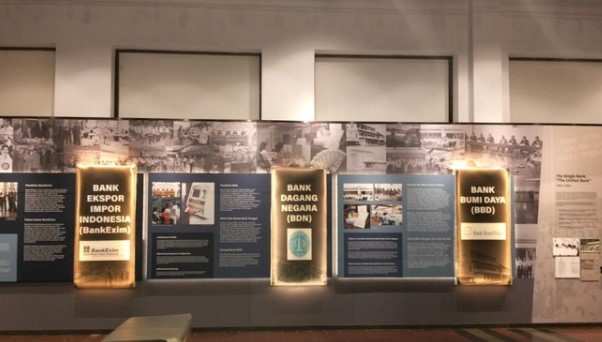
Since 1968, the building has been used by Bank Ekspor Impor Indonesia (Bank Exim). Bank Mandiri was then established in 1998 as the result of national banking restructuring. A year later, Bank Exim, along with Bank Dagang Negara, Bank Bumi Daya, and Bank Pembangunan Indonesia, officially merged into Bank Mandiri.
The De Factorij building was later designated a Cultural Heritage Building under Jakarta Governor’s Decree No. 475 of 1993. Since 2005, the building has served as Museum Mandiri.
Stained Glass: A Cure for Homesickness
One element that immediately catches the eye upon entering the staircase leading to the boardroom is a large stained glass window. For those unfamiliar, stained glass is a decorative art form created from colored glass pieces arranged into an image or composition.
When light passes through, the colors in the glass come vividly to life. At Museum Mandiri, this stained glass isn’t merely decorative. This piece, designed by F.H. Abbing Jr., carries its own deeper meaning.
The most striking section depicts Europe’s four seasons: spring, summer, autumn, and winter. These four seasons served as a kind of “time machine” for Dutch workers in Batavia, helping them recall life back in their home country.
Scenes depicting activities tied to each season served as a reminder of an atmosphere far removed from Batavia. For Dutch workers living in the East Indies, this stained glass became something of a remedy for homesickness.
But this stained glass doesn’t only tell the story of the Netherlands. Tucked within it are also depictions of life in Indonesia during the Dutch East Indies era. One example is a female figure depicted in revealing attire.
This figure represents the openness of East Indies society toward the introduction of Dutch culture. It also symbolizes how cultural differences were accepted and approached with tolerance.
Beyond culture, the natural beauty of the archipelago is also depicted within the stained glass ornaments. One example is an illustration of a smoking volcanic mountain. The archipelago’s landscape, so different from the Dutch homeland, was one of the things that captured their attention upon arriving in this region.
The volcanic mountains scattered across the archipelago became part of the natural uniqueness they encountered here. In many ways, the Museum Mandiri building itself can be considered part of its own collection. So next time you’re in the area, step inside Museum Mandiri and take a closer look at the decades-long story hidden within it.