
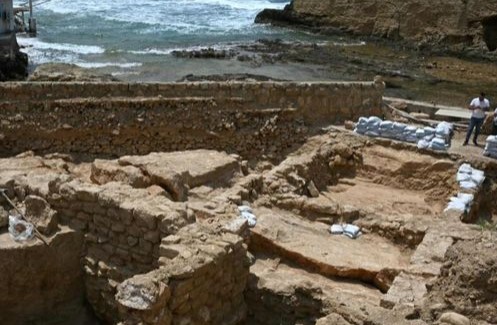
Archaeological discoveries in Lebanon keep emerging. However, excavations at several historical sites have had to be halted due to the ongoing conflict between Israel and Hezbollah.
One of the latest finds comes from Maasser al-Shouf, a mountainous area southeast of Beirut. Archaeologists have uncovered the remains of columns and the foundation of a Roman temple, estimated to date from the first century BCE to the second century CE.
Myriam Ziade, an antiquities official at Lebanon’s Ministry of Culture, said the area features a much larger building system.
“A complete complex was built around this temple,” she said, as quoted by The Star on Thursday (September 3, 2026).
The site was later converted into a fortress during the 12th to 13th centuries, during the Crusader period. The discovery began back in 2017, after local authorities found large stone blocks on a hillside.
Five years later, excavation work carried out alongside a team from an Italian university uncovered a large-scale temple ruin. Excavations at the site are now planned to resume.
Ziade explained that this site sits along a road network connecting the Mediterranean coast to the Bekaa Valley. Not far from there lies Baalbek, famous for its well-preserved Roman temple complex, one of Lebanon’s most iconic landmarks.
A Rich Archaeological Legacy Under Threat
Lebanon is indeed rich with remains spanning multiple historical periods, from the Phoenician, Persian, Roman, and Byzantine eras to the Crusader period and various Arab-Islamic sultanates and empires. However, renewed conflict has taken a toll on archaeological activity across the country.
After Iran-backed Hezbollah became involved in fighting in the Middle East back in March, Israel launched airstrikes and a ground invasion in southern Lebanon. UNESCO subsequently added several Lebanese sites to its List of World Heritage in Danger, including the ancient city of Tyre, home to Roman-era ruins and a second-century hippodrome.
Five fortresses in the Jabal Amel region of southern Lebanon were also added to that list. Among them is Beaufort Castle, a Crusader-era fortress captured by Israeli forces in May.
“We’re now focused on protecting the cultural heritage under threat in southern Lebanon and the Bekaa Valley, particularly the Baalbek region,” said Sarkis Khoury, Director-General of Antiquities at Lebanon’s Ministry of Culture.
“Excavations in dangerous areas have been suspended, and archaeological missions across Lebanon are currently operating at a very minimal level, particularly in the southern region,” he added.
Foreign archaeological teams have also reportedly stopped coming to Lebanon altogether. That said, excavation work continues in several northern regions.
Discoveries Continuing in the North
In Batroun, archaeologists uncovered a Roman-era olive press on a private plot of land, complete with pottery weights and objects related to textile production. At another location, two quarries were discovered, one dating to the Roman period and the other to the Phoenician era.
Archaeologists have also uncovered rooms from the Phoenician, Persian, and Roman periods, fragments of Greek pottery, and large storage jars used for goods from the port. These findings point to a once-thriving trade hub in the ancient city.
Meanwhile, in Beirut, excavations are taking place alongside ongoing construction projects. Archaeologist Laure Salloum said workers frequently uncover historical remains during construction, including a Roman-era olive press.
Her team is also still searching for remaining sections of a Roman hippodrome, first discovered during construction of a commercial and residential complex. Another find in Beirut is a Roman-era bathhouse, estimated to be around 2,000 years old.